
Call us at 415-392-3200  I  Contact Us  I  Services  I  About Dr. Turek  I  Library  I  Press
Turek Clinic Turek Clinic
Turek Clinic Turek Clinic Turek Clinic
Turek Clinic

SURGICAL SPERM RETRIEVAL


"WHATEVER YOU DO TO A MALE PATIENT WHO WANTS A FERTILITY PROCEDURE,
TRY TO DO IT ONLY ONCE. YOU MAKE MORE FRIENDS THAT WAY" - DR. PAUL TUREK

What are sperm retrieval procedures?

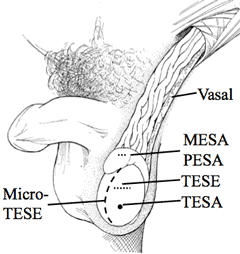
Sperm retrieval procedures are designed to collect sperm from organs within the male reproductive tract. First developed in 1985, sperm retrieval combined with in vitro fertilization (IVF) and ICSI have become invaluable techniques to allow infertile men without ejaculated sperm the opportunity to become fathers. These procedures are largely performed in men who produce an ejaculate without sperm, for whatever reason. They are also useful for men who are unable to produce an ejaculate. Sperm can be obtained from 3 sources in the reproductive tract, including the vas deferens, epididymis and testicle (Figure 1). They are used for men in whom the transport of sperm is not possible because the ducts that normally carry sperm to the ejaculate are absent, blocked or unreconstructable, or if sperm production is low.

places where sperm can be retrieved in a sperm retrieval procedure FIGURE 1. PLACES WHERE SPERM
CAN BE RETRIEVED IN MEN AND
THE NAMES OF THE DIFFERENT
PROCEDURES USED. ACRONYMS
ARE DEFINED IN TEXT.

BACK TO TOP

What kind of assisted reproduction technology is needed
to conceive with retrieved sperm?

Because retrieved sperm comes from organs in the reproductive tract, they are not considered fully "mature." Genetically, they may be fine, but sperm learn how to move (motility), how to find an egg (capacitation) and how to meet and penetrate an egg (fertilization) after they leave the testis and before they are ejaculated. These processes are learned as the sperm pass through organs of the reproductive tract. Therefore, assisted reproduction is needed for these sperm to result in a pregnancy. The level of assisted reproduction required by retrieved sperm depends on from where they are retrieved, and is outlined in Table 1.

Procedure Source Organ IUI IVF ICSI
Vasal Aspiration Vas deferens Yes Yes Maybe
Epididymal Aspiration
(MESA, PESA)
Epididymis Maybe Yes Yes
Testis (TESA, TESE, MicroTESE) Testicle No Yes Yes
TABLE 1. TYPES OF ASSISTED REPRODUCTION TECHNIQUES REQUIRED TO USE RETRIEVED SPERM

In general, most retrieved sperm are obtained from the epididymis or testis, and so IVF-ICSI is required for success. Dr. Turek is world renowned for his innovative published studies in sperm retrieval techniques and has treated hundreds of couples with these procedures.

BACK TO TOP

What is the bottom line about the "best" sperm
and the "best technique" for sperm retrieval?

From a critical look at what has been published to date about sperm retrieval, Dr. Turek has drawn the following conclusions about these techniques:

  • Given the lack of randomized, controlled studies (the best evidence) in this area, it is difficult to accurately say that any one technique is best or that any particular type of sperm is "best." Generally, Dr. Turek suggests retrieving the most "mature" sperm that can be found - vas deferens rather than epididymal rather than testis - as they are likely to work better and are easier to freeze for future use.
  • Although is it not difficult to retrieve sperm from men with a blockage, such as vasectomy, it can be very difficult to find sperm in men with testicular failure who have no sperm in the ejaculate.
  • Since IVF-ICSI does not have a 100% success rate in helping couples to conceive each time it is tried, it is important for urologists to use sperm retrieval techniques that are reliable and safe, and also to harvest enough sperm for multiple IVF-ICSI attempts without the need for repeat surgery. This is Dr. Turek's mantra.
  • BACK TO TOP

    What are the various kinds of sperm retrieval procedures that are available?

    The choice of a sperm retrieval procedure depends on the sperm sources available and patient preference. Dr. Turek offers patients the opportunity to choose whatever sperm they feel suits their needs the best. Refer to Figure 1 as you review this section on the different sperm retrieval techniques.

    VASAL SPERM ASPIRATION (PVSA, MVSA)

    Patients with congenital or acquired (injury, infection) blockages of the reproductive tract duct system near the prostate, or anywhere else outside of the scrotum, are candidates for this technique. In addition, men who are unable to ejaculate due to diabetes or spinal cord injury are also candidates for this. It is important for successful vasal sperm aspiration that sperm production in the testis be normal. The following suggest normal sperm production: a) normal testis size and b) normal serum follicle-stimulating hormone (FSH) and testosterone levels. The most direct way to verify normal sperm production is with a diagnostic testis biopsy but this is not always needed.

    Vasal sperm aspiration (Figure 1) is performed either along with wife's ovulation or in advance of ovulation, and the sperm are frozen and thawed for later use. It involves a brief, same-day procedure under local anesthesia, often with intravenous sedation, and performed is the manner of a No Scalpel vasectomy. Through a scrotal puncture the vas deferens is identified. Using microsurgical technique, a small incision or a puncture is made in the delicate muscular wall of the vas deferens and the clear fluid leaking from the vas is placed into syringes and assessed by an andrology laboratory. After sufficient sperm are obtained (>10-20 million), the wall of the vas deferens is closed with microscopic sutures. The recovery period is about 24 hours. Complications of the procedure include low risks of bleeding (1%) and infection (1%) that accompany scrotal surgery in general, and the potential that a scar will form in the lumen vas deferens and block it later (5%).

    Among the 3 sources of retrieved sperm, vasal sperm are the most "mature" or fertilizable sperm, as this sperm has already passed through the epididymis, where sperm maturation occurs. Although vasal sperm are most commonly used with IVF-ICSI, its maturity of this sperm is reflected by the fact that pregnancies have been achieved with vasal sperm and intrauterine insemination (IUI). Excellent sperm motility can be expected, depending on the condition for which vasal aspiration is performed. In Dr. Turek's study of vasal aspiration in previously fertile men, a mean sperm motility of 71% was observed (Table 2). Egg fertilization rates similar to that found with ejaculated sperm can be expected with vasal sperm.

    Aspirated Sperm Motility (%) % Alive
    Fresh Thawed Fresh Thawed
    Testis 5% 0.2% 86% 46%
    Epididymis 22% 7% 57% 24%
    Vas Deferens 71% 38% 91% 51%
    Note: these are mean values. Data from: Bachtell et al. Hum Reprod 1999, 14: 101-104.
    TABLE 2. MOTILITY OF RETRIEVED SPERM FROM THE VAS DEFERENS, EPIDIDYMIS AND TESTIS IN DR. TUREK'S STUDY.

    EPIDIDYMAL SPERM ASPIRATION (MESA, PESA)

    Epididymal sperm aspiration (Figure 1) is performed when the vas deferens is either absent such as with congenital absence or is scarred from prior surgery, trauma or infection. It is also performed in cases of anejaculation due to diabetes or spinal cord injury. It is performed in a manner similar to vasal sperm aspiration and can also be done at the time of the wife's ovulation for IVF or in advance of IVF and frozen and thawed for use. This technique is also useful for banking sperm during epididymovasostomy after vasectomy. Similar to vasal sperm, epididymal sperm retrieval is most successful when sperm production in the testis is normal. This procedure is performed under local anesthesia with or without intravenous sedation. The recovery period after this same day procedure is about 24 hours.

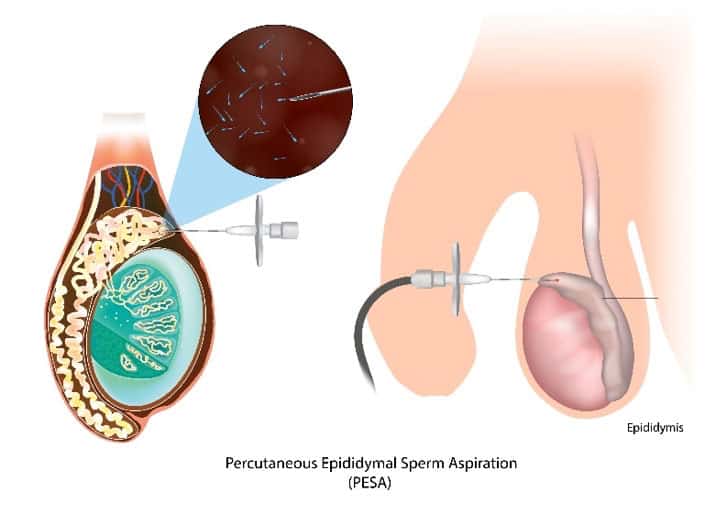
    Two different approaches to epididymal sperm aspiration are commonly used: microscopic epididymal sperm aspiration (MESA) in which a microscope is used to help find sperm, and percutaneous epididymal sperm aspiration (PESA) in which sperm are aspirated blindly from the epididymis through the skin. The most important difference between these techniques is that individual epididymal tubules are sampled for sperm with MESA, but multiple epididymal tubules are sampled blindly with PESA. This fact means that less sperm of lower motility are the likely result of using PESA which translates into less bankability of sperm. This increases the need to repeat the procedure if more sperm are required in the future.

    Either way, when 10-20 million sperm are obtained, the epididymal tubule is closed with microscopic suture, and the sperm are processed for assisted reproduction. Epididymal sperm are not as "mature" as vasal sperm that have traversed the entire length of the epididymis. As a consequence, epididymal sperm usually require IVF-ICSI for pregnancy success (Table 1). Dr. Turek has published excellent egg fertilization (65-70%) and pregnancy rates (50%) using IVF-ICSI with epididymal sperm. Of course, these results may vary widely by institution and individuals. In addition, epididymal sperm tolerate the freeze-thaw process very well (Table 2) and are excellent sperm to bank and use for later IVF-ICSI cycles.

    TESTICULAR SPERM RETRIEVAL (TESA, TESE, MICROTESE)

    The newest of the three sperm aspiration techniques, testicular sperm retrieval, was first reported in 1993. This procedure is indicated for "blocked" patients in whom sperm production is normal and there is a blockage in the epididymis or elsewhere ("obstructive azoospermia"). It is also useful for men in whom sperm production is very low within the testis, such that so few sperm are produced that they cannot reach the ejaculate (termed "nonobstructive azoospermia").

    Testis Sperm Retrieval with Obstructive Azoospermia

    Obstructive azoospermia implies normal sperm production and blockage as a cause of no sperm in the ejaculate. This is suggested by normal FSH and testosterone levels or a testis biopsy that is normal. In men with obstruction, sperm from the testis can be retrieved by needle aspiration (TESA) or percutaneous or open surgical biopsy (TESE). Testis sperm retrieval is performed either on the day of the wife's ovulation or in advance of ovulation and the sperm are frozen and thawed for use. Similar to other sperm retrieval techniques, it is a same-day procedure under local anesthesia, with or without intravenous sedation.

    TESA is a non-surgical approach to sperm retrieval. It involves stabilization of the testis in the surgeon's hand followed by insertion of a hollow needle into the testis through the stretched scrotal skin. Dr. Turek's research has shown that sperm in obstructed testes are found everywhere and therefore the location of sperm aspiration matters little. Negative pressure is applied to the needle and several excursions of the needle (butterfly or angiocath) are made within the substance of the testis until testis tissue is observed within the tubing attached to the needle. The testis tissue within the needle and tubing is then expelled into Petri dishes or test tubes containing sperm medium and processed by the andrology laboratory for sperm. This procedure can be repeated on the same or opposite side until sufficient sperm are obtained for IVF-ICSI. The recovery period is also about 24 hours. Complications of the procedure include low risks of bleeding (1%) and infection (1%).

    Alternatively, nonsurgical or open surgical biopsies (TESE) can be used to obtain testis sperm. All are done under local anesthesia. Nonsurgical core biopsies are obtained in a manner similar to TESA, except that a biopsy "gun" typically used for prostate biopsies is used. There is a 1-5% chance of developing a blot clot or hematoma when testes are biopsied in this way. Surgical biopsies are performed according to the "window technique" in which a small incision is made in the scrotal skin and in the covering of the testis, and testis tissue is biopsied under direct vision. With this approach, recovery takes 24-48 hours, substantial amounts of tissue can be biopsied and bleeding and hematoma are minimized because it can be visibly controlled during the procedure. With the surgical technique there is a 1-2% rate of bleeding or infection.

    Among the 3 sources of retrieved sperm, testicular sperm are the least "mature" or fertilizable sperm. For this reason, IVF-ICSI is needed with testicular sperm (Table 1). Fresh testis sperm have a mean motility of 5% (Table 2), which is generally satisfactory for ICSI but make them far less "bankable" than either vasal sperm or epididymal sperm. Egg fertilization rates with ICSI using testis sperm are generally thought to be 5-10% lower than with epididymal or vasal sperm. The choice of a nonsurgical or surgical technique can matter if the couple would like to bank sperm for future IVF cycles. In general, the surgical techniques (TESE) can retrieve more testis sperm than the percutaneous (TESA) techniques and therefore might be better to avoid repeat procedures in the future.

    Testis Sperm Retrieval With Nonobstructive Azoospermia

    "WHAT IS FASCINATING ABOUT TESTIS BIOLOGY IS THAT NOT EVERY SPERM THAT GETS PRODUCED ACTUALLY MAKES IT INTO THE EJACULATE. THERE IS A THRESHOLD LEVEL OF SPERM PRODUCTION OVER WHICH SPERM SPILL OUT INTO THE EJACULATE, AND BELOW WHICH THEY DO NOT. I TAKE ADVANTAGE OF THIS BIOLOGICAL PHENOMENON TO HELP COUPLES CONCEIVE ALMOST EVERY DAY." - DR. PAUL TUREK

    Although testis sperm retrieval in obstructed men is not difficult, there is a failure to obtain sperm for IVF-ICSI in 25-50% of men with nonobstructive azoospermia due to the state of low sperm production. In addition, features including testicular size, history of ejaculated sperm, serum FSH or inhibin levels, or biopsy histology, do not accurately predict whether or not sperm will be recovered. One of the biggest issues in cases of testis sperm retrieval in men with low sperm production is that sperm production can be "patchy" or "focal" in nature, which makes sperm retrieval difficult. Because of this, several strategies exist to more accurately determine which men with nonobstructive azoospermia are candidates for IVF-ICSI and surgical techniques have been refined to minimize trauma during sperm harvest procedures. Several approaches have been taken for sperm harvesting, including multibiopsy TESE, microdissection TESE and Dr. Turek's invention, site-directed TESE after fine needle aspiration mapping.

    With Multibiopsy TESE, surgical testis biopsies are taken until enough sperm are obtained for IVF-ICSI, as sperm may not be present on all biopsies. This approach will produce sufficient sperm in 17-45% of cases and may require 15 biopsies to succeed. It is considered the most invasive strategy with the highest risk of permanent injury to the testis because of its random nature and the need for multiple testis incisions. A variant of this is simultaneous multibiopsy TESE with cryopreservation, which involves taking testis tissue by surgical biopsy for sperm retrieval and sperm banking. This procedure is performed in advance of IVF-ICSI to avoid potential cancellation of IVF-ICSI cycles if sperm harvest fails. Similar to the multibiopsy method, multiple biopsies are taken from the testis and the procedure terminated when satisfactory numbers of sperm are obtained for ICSI. All sperm are cryopreserved and then thawed for a future IVF cycle. There are issues that surround the use of frozen-thawed testis sperm as outlined in Table 2, which is that they tend to recover with far less motility (0.2%) than the original (5%) when fresh. The surgical risks of this approach are similar to the multibiopsy method.

    Microdissection TESE (Figure 1) was first reported in 1999 and is conceptually similar to the multibiopsy TESE but has important differences, including the use of microsurgery. This technique is based on the concept that seminiferous tubules that contain sperm are larger in diameter and whiter than those without active spermatogenesis. This difference can be detected with optical magnification which requires an operating room microscope. For this approach, a single large incision is made in the testis and the organ is "shelled" open (Figure 1). Selected enlarged tubules are then biopsied, thus reducing the volume of tissue excised. Less tissue is excised with this method than the multibiopsy method and sperm retrieval rates range from 43-63% of cases.

    Given the level of surgical invasiveness with microdissection, the issue of testis injury has been a concern with this and other TESE procedures. When both testicles are operated upon with these techniques, testosterone levels drop by 20% of pre-procedure levels 3 to 6 months after sperm retrieval, and achieve 95% return to baseline levels at 18 months. There is also a 7% decrease in seminiferous tubule volume and a 5% decrease in germ cell density within tubules, suggesting that sperm retrieval procedures may have lasting effects on testis function. Finally, when performed by experts, microdissection TESE appears to be at least as safe as any other sperm retrieval procedure, with a 1-2% chance of testis loss (and a requirement for lifelong hormone replacement) after the procedure.

    BACK TO TOP

    What technique does Dr. Turek prefer in cases of low
    sperm production and no ejaculated sperm?

    "MY TECHNIQUE OF FNA MAPPING INVOLVES A SIMPLE, SAFE, SYSTEMATIC, TEMPLATE-DRIVEN, NON-SURGICAL APPROACH TO LOCATE SPERM POCKETS IN THE TESTIS OF MEN WITH LOW SPERM PRODUCTION AND NO SPERM IN THE EJACULATE. THIS WAY, THEY KNOW THEY HAVE SPERM BEFORE COMMITTING TO AN IVF-ICSI CYCLE." - DR. PAUL TUREK

    Troubled, like most urologists, about the problems facing men with low sperm production and no ejaculated sperm, Dr. Turek took a very different approach and invented Fine Needle Aspiration Mapping and Map-Directed TESE for cases of non-obstructive azoospermia. This involves performing a small, non-surgical procedure termed fine needle aspiration (FNA) "mapping" in the office under local anesthesia in 30-40 minutes before IVF-ICSI to determine whether a patient is a candidate for successful future sperm retrieval and IVF-ICSI. An example of an FNA map is shown in Figure 2.

    example of typical fine needle aspiration tempate for sperm retrieval FIGURE 2. EXAMPLE OF A TYPICAL FINE
    NEEDLE ASPIRATION TEMPLATE OF 22
    SITES USED BY DR. TUREK TO LOCATE
    SPERM IN MEN WITH NO EJACULATED
    SPERM AND LOW SPERM PRODUCTION

    The type of information obtained from the FNA map includes: whether or not sperm are present in the testes, where they are present, and how much of the sperm is present. The map is then used literally like a roadmap to guide or "direct" TESE at the time of egg retrieval for IVF-ICSI. By having a "map" ahead of time, fewer and smaller biopsies are required to harvest sufficient sperm for ICSI. In addition, the variable of whether or not sperm are present is well defined in advance of IVF-ICSI. The FNA mapping procedure is well tolerated by patients with no reported complications after 600 cases that Dr. Turek has performed. Theoretical risks include hematoma, testis injury, and infection. Patients take an average of 2 pain pills afterwards and usually experience a nearly full recovery in < 24 hours..

    Based on sperm quantity and distribution in the testes from the map, sperm are retrieved by TESA, TESE or microdissection, proceeding in this sequence from the least to most invasive procedure. From a review of 3 recent years of mapped nonobstructive azoospermia cases (n=159) that Dr. Turek has performed, 44% of men required only nonsurgical TESA to have sperm retrieved, 33% required TESE and only 23% needed microdissection-TESE. In addition, most (78%) of these sperm retrieval cases were performed on only one side. Overall, sufficient sperm for all eggs retrieved at IVF (Dr. Turek's strict definition of success) are found in 95% of cases; with 100% of TESA/TESE cases and 80% of microdissection cases. In addition, among men who underwent a second sperm retrieval procedure, sperm were retrieved in 91% of attempts, and in men who had a third sperm retrieval, sperm were found in all cases. This suggests that knowledge of sperm location with FNA mapping can simplify and streamline sperm retrieval procedures in difficult cases of nonobstructive azoospermia. In addition, much has been learned about the biology of sperm production in severely infertile men with the FNA mapping technique.


    BACK TO TOP

    How does sperm banking help us with sperm retrieval procedures?

    The ability to freeze and thaw retrieved sperm is a significant advance in the care of men with no sperm in the ejaculate. It has simplified the timing and orchestration of fertility procedures performed on both partners, added convenience to scheduling, and allows couples who need IVF-ICSI to have multiple opportunities to conceive without repeating surgical sperm retrieval. Dr. Turek and others have advanced the idea that motile, frozen-thawed epididymal sperm have IVF-ICSI outcomes equal to fresh epididymal sperm and thus epididymal sperm retrieval procedures are commonly performed before IVF-ICSI cycles and the sperm frozen for later use.

    Banking of testicular sperm is a slightly more complicated scenario. In most centers, fresh testis sperm are preferred to frozen-thawed testis sperm. This preference is largely driven by the large decrease in motility observed after testis sperm are thawed (see Table 2), but it is also driven by the generally low or the occasional complete lack of motility observed in fresh testis sperm. Dr. Turek's experience has been to use motile testis sperm whenever possible, which often requires that it be retrieved fresh. However, given that fresh testis sperm have viability rates that approach 90% (Table 2), Dr. Turek does not require that fresh testis sperm be motile for IVF-ICSI, as viable sperm are all that are necessary for success. As Table 2 suggests, however, if nonmotile, frozen-thawed testis sperm are used for ICSI, a lower fertilization rate should be expected, as only 50% of sperm will be alive. This strategizing forms the basis for the recommendations that Dr. Turek gives to couples who are thinking about banking their retrieved sperm samples.

    BACK TO TOP

    What can I expect in terms of planning and recovery
    from an FNA mapping procedure?

    BEFORE THE FNA MAPPING PROCEDURE:

    1. Do not take aspirin, Advil, Motrin or any ibuprofen containing medications at least 10 days prior to the procedure. These medications have a side effect that can reduce platelet function and therefore lower blood-clotting ability (i.e., they are mild blood thinners).

    2. On the day of the procedure, please remember to do the following:

    A) Wear loose and comfortable clothing.
    B) Do NOT bring valuables or large amounts of money with you.
    C) Bring a "jock strap" or wear tight briefs

    3. Eat a light breakfast or lunch on the day of the procedure.

    4. If you plan to take Valium 1 hour before the procedure, make sure you have someone available to drive you to and from the procedure. Driving while taking Valium is dangerous.

    5. PLEASE SIGN THE CONSENT FORM BEFORE THE PROCEDURE. If you have taken valium before the consents are signed, then the procedure will be cancelled.

    AFTER THE FNA MAPPING PROCEDURE:

    1. Remove the dressing from inside the athletic supporter in 24 hours; continue with the scrotal support for 2 days and then return to normal your underwear. You can shower the day after the procedure.

    2. Apply frequent ice packs to the scrotum the night of surgery and the next morning. Do this by placing a thin towel on the scrotum (or scrotal support) and lay frozen peas (or mixed vegetables) in the bay on top of the towel. Keep the scrotum cool not cold. After 24 hours, discontinue the ice. You can apply moist heat (sparingly) to the scrotum after 5 days.

    3. Prescribed pain medication can be taken as directed. Extra-Strength Tylenol can also be taken, one or two pills every 6 hours as needed. Do not take aspirin-like drugs like Ibuprofen (Advil, Motrin) for at least 3 days after surgery, to allow your blood to clot normally.

    4. There are no sutures to remove. Scrotal swelling will peak in 24-48 hours and may take several days to weeks to resolve after that.

    5. Resume a normal, well-balanced diet when you return home. Be sure to include lots of fluids.

    6. Normal, non-vigorous activity can be restarted after 24 hours or when you feel better. Activities that cause discomfort should be stopped for the time being. Heavy activities such as jogging and weight lifting can be resumed in 5 days. You may return to work when comfortable.

    7. Refrain from sexual intercourse for 5 days.

    8. Dr. Turek will call you at home in 10-14 days to discuss the FNA findings. Please call 415-392-3200 for results if you do not hear from him within 2 weeks.

    9. You may experience discomfort after the procedure. Common discomforts or symptoms include the following and do not require a doctor's attention:

    A) Bruising and discoloration of the scrotal skin. This will take one week to go away.

    B) A small degree of scrotal swelling.

    10. Postoperative complications are rare. If either of the following occurs, you should seek prompt medical attention by calling Dr. Paul Turek or one of his associates at 415-392-3200:

    A) Wound Infection. This may be associated with a fever, a warm, swollen, red and painful incision area, with pus draining from the site. Antibiotics are necessary to treat this.

    B) Scrotal Hematoma. Extreme discoloration (black and blue) of the skin occurs from bleeding underneath and can cause throbbing pain and a bulging of the wound. This may need to be drained.

    BACK TO TOP

    What can I expect in terms of planning and recovery
    from a sperm retrieval procedure?

    BEFORE THE MESA/TESE/MICRODISSECTION PROCEDURE:

    1. Do not take aspirin, Advil, Motrin or any ibuprofen containing medications at least 10 days prior to the procedure. These medications have a side effect that can reduce platelet function and therefore lower blood-clotting ability (i.e. are mild blood thinners).

    2. On the day of the procedure, please remember the following:

    A) Wear loose and comfortable clothing

    B) Do NOT bring valuables or large amounts of money with you.

    C) Do not eat or drink anything after midnight on the day prior to your procedure. (Morning medications can be taken with a small sip of water.)

    3. If you are to receive sedative medication by vein along with the local anesthesia, it is very important that you arrange for another person to take you home after the procedure. The Hospital WILL NOT allow you to leave without an escort if you have received sedation by vein. If your partner's egg retrieval is scheduled the same day as your aspiration, then an escort will be needed for both of you.

    IMMEDIATELY AFTER THE TESA/TESE/MICRODISSECTION PROCEDURE:

    1. Remove all dressings from inside the athletic supporter in 48 hours; continue with the scrotal support for 3 days total. You can shower the day after the procedure.

    2. Apply frequent ice packs to the scrotum the night of surgery and the day after. After 24 hours, discontinue the ice. You can apply moist heat (sparingly) to the scrotum after 5 days.

    3. Prescribed pain medication can be taken as directed. Two days after surgery, Extra-Strength Tylenol or Ibuprofen (Advil, Motrin) should be sufficient for pain relief. These are over-the-counter medications.

    4. The wound is closed with absorbable sutures. They do not need to be removed. It may take up to two or three weeks for sutures to dissolve.

    5. Resume a normal, well-balanced diet when you return home. Start with easily digested soups and broths if you are not feeling perfectly normal. Be sure to include lots of fluids.

    6. Normal, non-vigorous activity can be restarted after 48 hours or when you feel better. Activities that cause discomfort should be stopped for the time being. Strenuous activities such as jogging and weight lifting can be resumed in 1 week. You may return to work when comfortable.

    7. Refrain from sexual intercourse for 5 days.

    8. Please return to the office in 7-10 days for a wound check and a discussion of the findings. Please call 415-392-3200 to make an appointment. If you had a microdissection procedure on both sides, then Dr. Turek will need to monitor your male hormone (testosterone) levels immediately after the procedure and for 6 months afterwards.

    9. You may experience discomfort after the procedure. Common discomforts or symptoms include the following and do not require a doctor's attention:

    A) Bruising and discoloration of the scrotal skin and base of penis. This will take 7-10 days to go away.

    B) Some degree of scrotal swelling. It will peak at about 72 hours post-procedure and resolve after that.

    C) A small amount of thin, clear, pinkish fluid may drain from the incision for a few days after surgery. This is normal. Keep the area clean and dry.

    D) If you received general anesthesia, a sore throat, nausea, constipation, and general "body ache" may occur. These problems should resolve within 48 hours.

    10. Postoperative complications are rare. If the following occur, you should seek prompt medical attention by calling Dr. Paul Turek or one of his associates at 415-392-3200.

    A) Wound Infection. This may be associated with a fever, a warm, swollen, red and painful incision area, with pus draining from the site. Antibiotics are necessary to treat this.

    B) Scrotal Hematoma. Extreme discoloration (black and blue) of the skin occurs from bleeding underneath and can cause throbbing pain and a bulging of the wound. This may need to be drained.

    BACK TO TOP

    Turek Clinic
    Turek Clinic Turek Clinic Turek Clinic
    Turek Clinic The Turek Clinic
    Turek Clinic Turek Clinic Turek Clinic Turek Clinic
    Copyright Turek


    The Turek Clinic, located in the Northern California San Francisco Bay Area, is a unique men's health clinic dedicated to improving men's reproductive health and male fertility issues. Dr. Paul Turek, our director, is an internationally recognized urologist and dedicated microsurgeon who uses the latest techniques for vasectomy and vasectomy reversal. These include the "no scalpel" vasectomy reversal as well as a form of vasectomy reversal known as invagination epididymovasostomy. Vasectomy and vasectomy reversal costs are not insignificant, so it is important to have a clinic, like ours, which is known to have the highest vasectomy reversal success rates with the fewest complications. Our male fertility specialists can also discuss with you vasectomy and vasectomy reversal alternatives that make sense for you. Contact us now at 415-392-3200 for a consultation. Also, check out our library for extensive information on vasectomies, vasectomy reversals, variocele repair and other minimally invasive procedures.